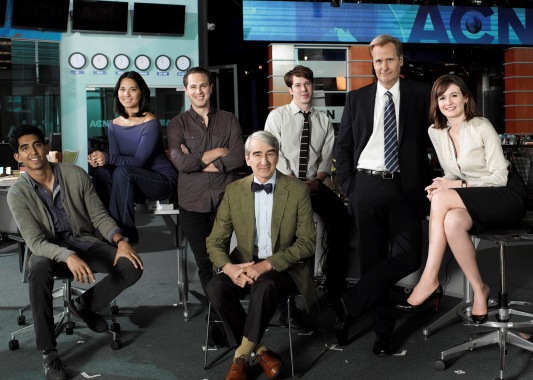
This week in class we viewed two episodes of The Newsroom, written by Aron Sorkin. The American television drama series premiered on HBO in 2012 for three seasons. The Newsroom stared well-known actor Jeff Daniels as Will McAvoy. Jeff Daniels won an Emmy award for this portrayal of a popular news anchor struggling to find the balance between ratings and delivering real news. Other actors and actresses featured in the show are Emily Mortimer, John Gallagher Jr., Alison Pill, Thomas Sadoski, Dev Patel, Olivia Munn and Sam Waterston.
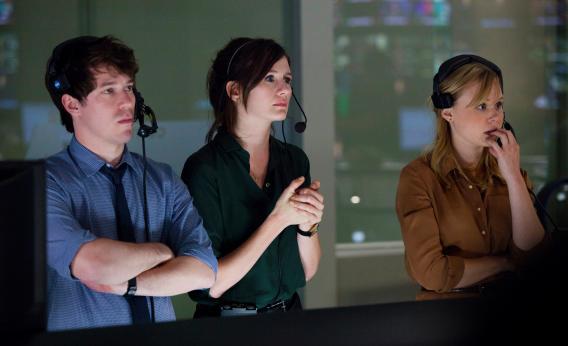
Cast of the TV drama The Newsroom
The Newsroom shows behind-the-scenes events that transpire at the Atlantis Cable News (ACN) station. The series kicks off with Will McAvoy exploding during a debate after being asked, “What makes America the greatest country in the world?”. He flips the script and goes on the offensive to explain the flaws that lie within the United States government and that we are no longer the greatest country in the world. Charlie Skinner (Sam Waterston) the director of ACN, hires a new executive producer without informing Will McAvoy. The new E.P. happens to be Will’s ex, Mackenzie, who he has not seen or spoken to in three years. The two hashed out their differences and the episode then turns to the Deepwater Horizon oil spill in the Gulf of Mexico. The news team throws the previous stories out and run the oil spill piece completely off script. They successfully deliver the coverage and facts of the spill in exciting fashion. The first episode ends dramatically with Will and Mackenzie sharing a moment from their first date. This leaves the audience craving more outlandish states, romance and wondering what direction the Atlantis Cable News will take next.
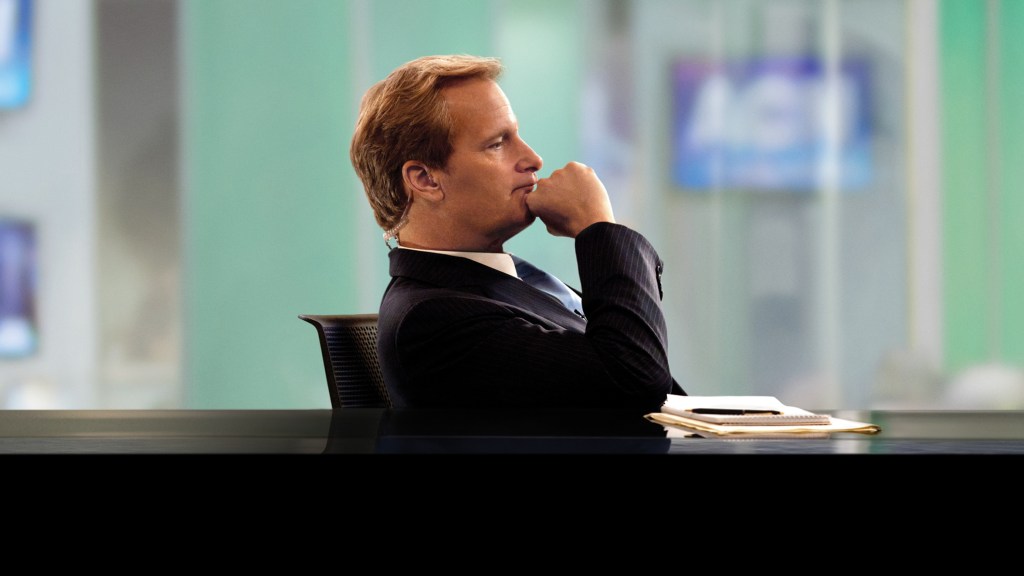
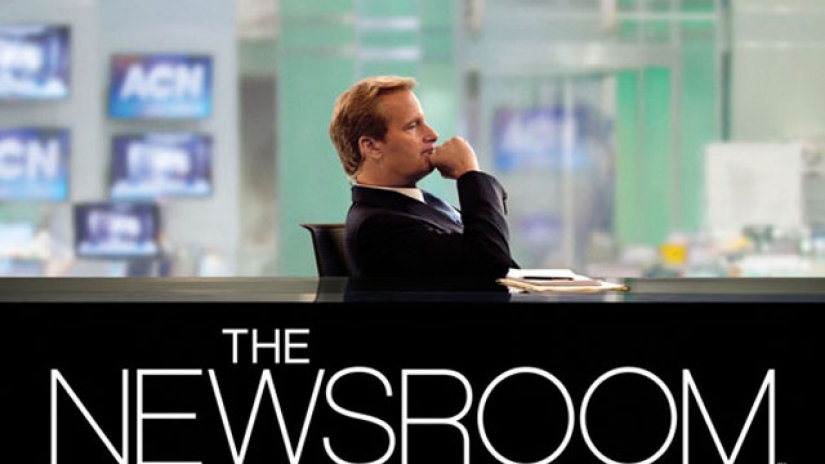
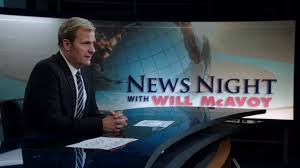
Jeff Daniels stars as Will McAvoy in The Newsroom
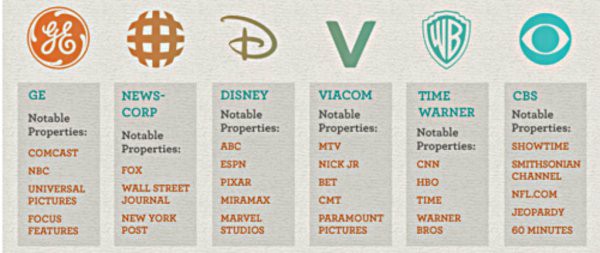
Another topic of discussion in class on Wednesday was the major conglomerates that control almost all aspects of television, news and film in American life. The six major conglomerates are GE, News-Corp, Disney, Viacom, Time Warner and CBS. Notable properties of these organizations are Universal Pictures and NBC (GE), the New York Post and the Wall Street Journal (News-Corp), ESPN and Marvel Studios (Disney), MTV and Paramount Pictures (Time Warner), and Jeopardy and 60 minutes on CBS. These massive industry giants control 70% of your cable television and had a total revenue of 275.9 billion dollars in 2010. The profit the big six corporations have increased in millions if not billions of dollars in 2019. The six major conglomerates only do not control about 10% of the media in American life.
In class this week, we watched two episodes ”The Newsroom”. I have seen the pilot episode before but the second one i never really seen before. I still loved the pilot episode. The first episode is all about the news anchor Will McAvoy who comes back from vacation after an embarrassing pubic incident at an university. He comes back to find that half of his staff are leaving to go work for a different new anchor. His boss then hires his ex-girlfriend Mackenzie MacHale to be his new executive producer. This makes Will very upset, but his boss says that it can help him a lot and that it can work. An issue that a lot of news channels have is figuring what issues are worth pursing and see how much views it can bring in. A news alert came through the news station about an explosion in the Gulf of Mexico, many of his people, working for Will don’t see it as it’s very important and tell him that it won’t gain him a lot of views. As the team did their own research, they find out that it is an oil spill that had been yet to be plugged. McAvoy and his pursue the issue and are the only ones to broadcast it on the airwaves that night. Other news stations had not yet realized the big issue of the oil spill and it was very good for McAvoy to have displayed this news out fast. I really loved the episode because they did a great job displaying the news story and seeing if it would help the situation or if it would be beneficial for the public.
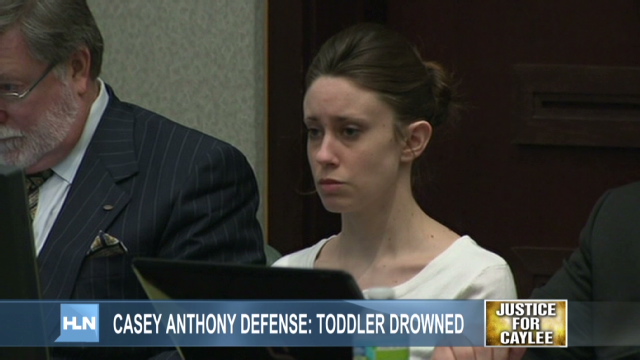
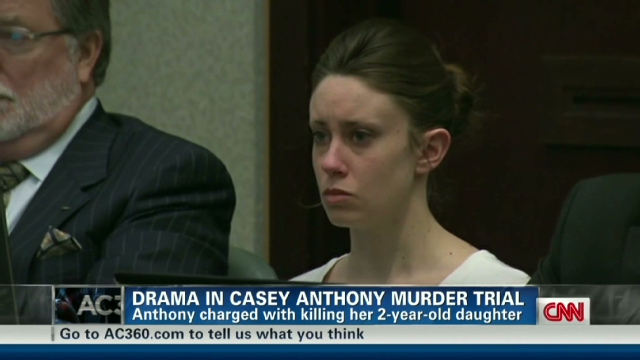
In the next episode of the Newsroom, there was issues with what they wanted to broadcast. The issue was what the public wanted to hear and not for entertainment or relying on actual news. McAvoy show took a big hit after not covering the Casey Anthony trial. McAovys and his team wants to cover real and actual news that is actually important to the public. After they lose half of their views to Nancy Grace, they decide that it was time to make a change and put on the Casey Anthony trial. The team decides that they want to stay on top of the news that is going on and they start to report about the trial in case their views come back, The episode shows you that sometimes the news doesn’t show you important information and they are just showing you what is going around in the world or in our country.
This week we discussed news and recent trends of news being subjective instead of objective. In the screening of two episodes of The Newsroom, one major theme follows the plot of the show. It is the idea that news in the modern era has become extremely bipartisan, and the protagonists of the show are striving to combat this trend by reporting the news as an objective item. They want to allow the audience to create their own opinions about events happening in the world. The main character Will McAvoy is the main anchor for the show and believes his viewers are not complete mouth breathers that must be told exactly what to think.
Conflict arises in the second episode when the team decides not to report on the Casey Anthony Case. They believe the case is not worth reporting on because it replicates basic television drama. As a result, they end up losing half of their audience to a Nancy Grace show that did report the Casey Anthony Case. The team decides that because of this decline in the audience they must report on the controversial case within the next week. This creates a problem that all newscasts face. Whether they should focus on reporting stories that their audience is interested in seeing, or whether they should report on stories and issues that they believe are important for their audience to be informed on.
Overall, I believe The Newsroom is successful in terms of presenting issues that impact the current way we ingest current events. In the first episode, Will is criticized during an interview for not taking a political stance as a news anchor. After being taunted about this, he finally blows up and chastises other news anchors for voicing their political affiliations. He believes that current events should not be reported with a liberal or conservative spin on the content, for this could alter how an audience ingests the information given to them.
Today, we are given the illusion of choice when it comes to entertainment options. Entertainment corporations such as Disney, Viacom, and Time Warner have consolidated all media into massive media monopolies. In fact, there are only six major corporations that are currently in control of the industry. As opposed to thirty years ago when there where approximately fifty companies involved in the industry. This move towards massive conglomerates creates little to no competition in the industry. It also means that all of our information and entertainment comes from only five or six giant corporations. However, these massive conglomerates are not just a one-sided evil villain. Their massive size means they need to produce more content than ever. This creates an opportunity for jobs in all aspects of production. From directing to costume design there is a demand for workers in this field. As easy as it is to become pissed off by a mass take over of corporations, at least I can rest easy knowing that this is the best time for post-college graduates to enter the entertainment field.
This week we watched two episodes from “The Newsroom” We watched the pilot. “The Newsroom” is about a news group who endeavors to make a news show that reports the news in a moral and sensible manner. They take genuine, newsworthy occasions from our reality as they’re occurring and report on them as though they were a real news station that pursued normal and good rules, in a gnawing analysis of our famous press and a cunning obscuring of craftsmanship and reality. Will McAvoy, the new anchor is wanting to carry something new to television. His producer, McKenzie MacHale, who was once impractically engaged with the new boss wouldn’t like to have her staff think about it, only a couple of all around associated companions. The present tattle condition saturates into this offering which as it were, doesn’t show anything new, so far as that is concerned. The show begins with Will McAvoy, played by Jeff Daniels, responding to questions at a nearby school. Furthermore, in the wake of utilizing a little humor to get passed questions he would not like to reply, he at last snaps when the host requests his supposition if America is the greatest country in the world. Not only does he lash out at a college girl, but he also lashes out on the country that turns his career for the worse. Mr. McAvoy is the head stay at Atlantis Cable News (ACN) and when he comes back to work after his lash out, he realizes the vast majority of his staff is gone from the newsroom. As he examines what occurred with the head administrator of the system Charlie Skinnern, understands that his manager contracted another official maker for the show without allowing Will to meet her. Notably, the new official maker is Mackenzie McHale, who has had a relationship with Will in the past that turned sour. It doesn’t take Will long for him to be totally angry with the entire quandary yet needs to confront realities that she will help spare his show after his outburst.
We then watched “The Blackout, Part 1: Tragedy Porn”. In the Blackout Part 1, Charlie, McAvoy, and MacKenzie have no choice but to cover the Casey Anthony trial despite their protest due to Nancy Grace securing a large bit of their audience. They treat it with little-to-no soul or heart, allowing this to infiltrate the importance of their news broadcasts, while Sloan is adamant that Mac report a major economic story on the potential of a devastating collapse of the currency and a debt ceiling ordeal that would affect not just America but the world at large.
Jeff Daniels is flawless in his role as the worn out thrashed writer that simply doesn’t care the slightest bit about anything any longer, yet utilized as well. What’s more, we can see the sparkle that touches off him to become extraordinary once more.
In class this week we focused primarily on the television show the Newsroom. Although I have never seen the show prior to class, I found it to be very interesting and informative. The show relayed issues with modern day news that isn’t always necessarily seen by the public. A major issue that the show faced was whether it should relay real modern-day issues or if it should just be for pure entertainment. Many people in the show had different opinions on what to broadcast to the public and they would often times clash heads on these issues.
The first episode of the Newsroom that we watched in class was the pilot of the show, called “ We Just Decided To”. Will McAvoy, the main news anchor at Atlantis Cable News is just coming back from vacation, after a very embarrassing public accident. McAvoy is surprised to find out that almost all of the people who work under him are leaving him to go work for a different news anchor. His boss also hired his ex-girlfriend Mackenzie MacHale as his executive producer. This makes McAvoy very upset, but his boss insists that MacHale will be of much help to Will. A major issue that many news channels face is figuring out what issues are worth pursuing. A news alert comes through the station about an explosion in the Gulf of Mexico, many of the people working for Will see it as something that is not important and tell him that it won’t get a lot of views. As the team does more research, they come to find out that it is an oil spill that had been yet to be plugged. McAvoy and his team pursue the issue and are the only ones to do a show on the oil spill that night. Other news stations had not yet realized the severity of the issue and it was very beneficial that McAvoy displayed this news. The first episode did a good job at displaying an issue that a news station can often have, which is deciding what news to broadcast and whether it will be beneficial to the public.
While watching another episode of the Newsroom in class, we saw an ongoing issue that newsrooms face. This issue deciding to broadcast what the public wants to hear for entertainment or relaying actual news. McAvoys show took a major hit after not covering the Casey Anthony trial. McAvoys and his team’s philosophy is to cover real news that is actually important to the public. After losing nearly half of their viewers, they decide that it is time to make a change. The team wants to stay on top of other news channels and reports about the Casey Anthony case in hopes to earn back their viewers. This episode showed that sometimes the news isn’t necessarily showing you the most important information, but it is showing you what the public wants to hear about.
This week we focused on the news. You can get the news from many different news stations. Cable news covers many different platforms and sides of important things going on in our nation. You can get your news from MSNBC, NBC, FOX, CNN and many other places. However some of it may not always be the truth and depending on the channel can depict it in a liberal or conservative fashion. But the problem with cable news today, is that many people are concerned with the fact that most of these platforms can show fake news. Some news anchors report news that may not be true. The people then will sometimes believe it because the way it is reported may sound true. Some reporters can be trusted but sometimes others cannot. Being sure that you look up facts on what is being reported can be important because it is not illegal for them to say something that isn’t true. I personally am not someone that watches the news much anymore. I have found the news to be very depressing. Most of the time on the news you see something about a mass shooting or something bad happening around the world. I also do not watch much anymore because it is usually just a debate over politics and people yelling at each other on the screen. Very rarely is there something good that is happening but it seems like even when there is they find a negative light on it. I have the app for the Washington Post and the New York Post on my phones, but the only time I find myself checking it is when I get an alert about something.
This week we also watched two episodes of the Newsroom. I have seen the pilot episode in Social Media and Society before, but the second one was new to me. I still very much enjoyed the pilot episode. The makers of the Newsroom really put so much work into the show to show how reporting of the news takes a lot of work and can at times be very frustrating. The second episode we watched I found very interesting. Will and Mac were faced at the beginning of the episode finding out that their rates had took a major dip the week before. They are then forced to cover the Casey Anthony trial instead of looking at major things like the debt ceiling vote. Will also hires the guy Mac cheated on him with to write a story on the Newsroom 2.0. We even find out about a whistleblower too and a congressmen who had an affair. Everyone is faced with a great amount of stress in this episode and try to handle it as best as they can. With this episode it is obvious that the news can get many stories but has to choose which ones they want to report and can be the best for ratings. They may not always make the best decisions but they have to take into mind what the country wants to see.
This week in class we continued to cover the news and how it can shape our opinions on different topics. One of the largest forms of news available, cable news, can be a very misleading outlet for people who are looking to find news, especially if the person looking of it does not know what they are looking for. Many news channels tend to lean one way or the other when it comes to politics, and if you are unaware of that, you can get very misleading information about any number of topics. This can be from either the pundits and producers only giving the side of the issue that shows their party in the better way, or by the pundits telling lies about someone or something to make their party seem innocent or better than the other.
This idea was shown in and also tried to be refuted in by a team in the show “The Newsroom”, a show about a news team that wants to be more truthful about that news and wants to show more meaningful news to its viewers. The anchor, Will McAvoy, is someone who wants to be able to keep his ratings up, and he gets help doing this from his new executive producer, McKenzie McHale, who wants to show real and important news to those who watches their program. The first episode we saw dealt with the BP oil spill off the coast of Louisiana in 2010, and in the show their program was the first to have any coverage of the accident. Every other news program showed a different story to begin with, while they had a full hour coverage of what was going on. This showed that they were worried about something that was of major importance to almost every person in the country versus something that would only bring in people watching for entertainment, like most news programs seem to do today.
In the second episode we watched of “The Newsroom”, they talked about the controversy that was the Casey Anthony trial. In this episode, McAvoy and McHale had a disagreement over whether or not to cover the trial like the other programs. Their program had lost half their viewers to HLN’s Nancy Grace, who was covering the trial. McKenzie did not believe that it was important enough to show, while McAvoy wanted to do whatever it took to keep his viewers so they could host a debate on their show. This correlates to real life because there are many news stations that show the viewers the entertaining things to keep them around, so that they in turn get more money for their station. What is so good about this episode is the way that McKenzie argues against covering this kind of story when she goes into the staff meeting and starts marking off the topics they were going to cover in a very dramatic fashion. The way it ends is also great as they are planning to prerecord an interview with a woman about Anthony Weiner and what has happened with his Twitter account, and right before the interview that McKenzie does not want to do, the power shuts off. She asks for a sign to not go on with the interview, and after the power shuts off says “I didn’t think you had that comic timing”, which I think is a great line.
Millions of viewers of all ages turn into the news every night. The news is a form of media, and many people have came up with their own acronyms for news. Many people have came to believe that the word ‘news’ is actually an acronym for Notable Events, Weather and Sport; that is because news is supposed to broadcast this important information.
So… what actually makes news news then?
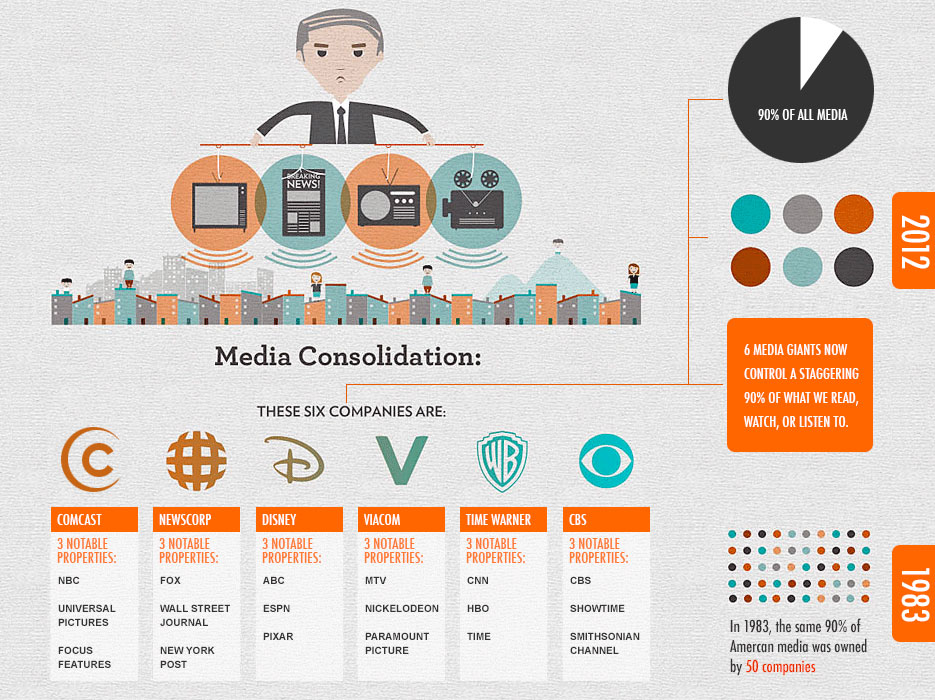
Well ask the six major companies that control a 90% of the media seen by Americans.
The figure below really visually amplifies the amount of control and power these SIX major companies have on the media we view everyday. Media has turned into a business with monopolies have the power to control what we see.
TV shows such as The News Room which aired on HBO (which BTW is owned by one of the major companies!) showed what news should be. Modern news has shifted from informing people to entertaining people. In the show a character, Will, is the news caster of a news show called “News Night,” and his show is trying to fix news. Instead of entertaining watchers and making profit the company aimed to give the viewers facts.
The show talked about how news should state facts and be straight forward. News currently can be very skewed towards different viewpoints depending on which channel a viewer decides to watch. In the show the news team is working on taking a moral-high road on news, which is something you don’t see very often today. News which omits facts or is purely for entertainment purposes can be described as
“FAKE NEWS.”
So what is news? Is it whatever the six major media companies want to show us? Is it entertainment and celebrities? Is it weather? It it what is going on with politics? How about what is going on with the world?
Is the news your watching even news or is it “fake news?”
I guess that depends on where a person gets their news from? CNN, FOX, ET, Twitter, Facebook?
Each of these stations may broadcast a different perspective on a story. Or maybe they will even broadcast different stories. So it is up to viewers’ discretion to decide where they get their news from and what stories are important to them.
There was a time in America where the news people were receiving was reliable and didn’t really have a lot of political bias like the modern day FOX news or MSNBC. There was a time where news Anchors had a lot of power because over many years of working within that industry they had built up trust with the people who watch it. Now people need to be educated on media because there is a heavy bias in certain media outlets. Words are twisted and the same story can be used as positive on one side but on the other negative. It is this reason why I have stopped watching cable news myself because a majority of the news is a lot people yelling at each other over different opinions. I also believe that this divide in news coverage has created a divide within our country. Republicans and democrats fight with each other day in and day out about what’s “right” and watching this from the outside has caused me to not really want to be a part of either side. Not to mention that what the news covers causes people to live in fear of how violent they think our society has become. When in fact our crime rates in America has been the lowest they’ve ever been. The news in the modern day society isn’t here to bring us the truth and they aren’t here exposing companies and letting the people in on important problems that need the nations attention. The news is now out for money and views and that means to broadcast anything that’s going to maximize their views. With our current president in place, Trump has called out the media for being “fake news” and this has caused a lot of news outlets to clean up their act. Why this is so relevant is because the News is supposed to be for the people and not for themselves, on top of that this could cause a lot of general distrust for the news anchors we used to know and trust. A lot of times they have no power over it either because if they want to report on something very relevant that isn’t all that interesting and their views drop a significant amount. Well then it looks like that news anchor is out of a job. Isn’t that something? The people in America need to be more educated on the news and fact check the news because everything people hear today are topics they fight about with friends and family members because they are always reinforced by a news outlet that only lines up with someones views. A great example of news outlets and anchors reporting on what matters and what doesn’t is a show called The News Room. These episodes show people what it’s like to have to deal with reporting on the truth or reporting on a topic that will get you more views. It will also show the consequences of what happens when your views tank and the stress of it all. In my opinion I don’t think everything within America should be treated like a business to fill your pockets with money. There are certain things like the news that should be taken very seriously and shouldn’t be used to manipulate an audience.
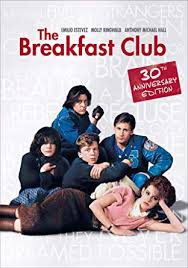
The history of filmmakers portrayed to the world, that a director can indeed be an artist. An artist is someone who practices or creates a work of art. In my opinion, certain directors are artists in their own special way. But, not all directors are artists, the auteur theory helps to convey the differences between the two. Auteur theory is the idea that the director of a film is the primary driving force behind the creation of a motion picture. In other words, the director is the author of the movie. The key differences between an ordinary director and one who uses the auteur theory is detecting the significance of the movie. Although the director is a very important role, sometimes other factors become more significant like the stars, studios, and producers. The auteur theory makes the director stand out in the film, and even become the reason why you watch the movie. A quote from the studio binder helps to convey this point when they said “People referred to a ‘Clark Gable movie’ for example, because in the 1930’s stars ruled the day. Auteur theory came in the early 1950’s, and it changed all that. It shifted some power away from actors, producers, and studio moguls while giving more power to specific types of directors. It ultimately led to a kind of director-crisis.” This director crisis directly correlates with a need for a director that has a signature stamp on how he/she creates the motion picture. The director I will be focusing on is none other than the famous John Hughes. John has been credited with the success of many films over his tenure, but the one film I will mainly be focusing on is The Breakfast Club.
John Hughes has been famously credited with the making of at least 41 films including famous titles like: Ferris Bueller’s Day Off, Sixteen Candles, each Home Alone, each Beethoven, The Breakfast Club, and multiple more highly anticipated movies. John Hughes was born in Michigan in 1950, and he was described himself as a “quiet kid who loved the Beatles.” “Aged 12, he and his family moved to the Chicago suburb North brook in Illinois. Navigating adolescence on the outskirts of a wealthy neighborhood, Hughes’ experiences at Glenbrook High School would inspire his work as a filmmaker.” (The Beginner’s Guide) After graduating high school in 1968 Hughes attended the University of Arizona, he dropped out of his junior year to pursue a career as a copywriter throughout the 70’s. This process helped kick start his film making career in 1983. John Hughes left an imprint on the directing world and was referred by Roger Elbert as “ the philosopher of adolescence”, Hughes’ work – which included eight directorial efforts and numerous screenplay credits – has influenced numerous directors, including Wes Anderson and Judd Apatow, and he endures as one of the most beloved filmmakers of the 1980’s. In John Hughes’s movies he depicts the teenage experience through his directing methods. His greatest contribution as a filmmaker, not just as a director, was the way that his films went against established stereotypes that were not exploited before. In a way, he revolutionized the movie making business by taking simple ideas and created a greater meaning that was previously overlooked. The theme that he portrays in many of his films is that teenagers go against the portrayed childish treatment, and are actually respected adults. He conveyed that growing up as a teenager is a difficult and complex journey that cannot be defined by a single element. This information proves how John Hughes is a director that uses the auteur theory, and depicts his theme into a multitude of movies.
In the movie The Breakfast Club the audience was easily able to pick up on John Hughes teenage theme. The movie begins with many close up shots of the highschool setting, and then proceeds to introduce the characters as they are being dropped off for detention. They all meet in an awkward environment, that is conveyed through full shot lenses, and are met by their detention advisor. Throughout the movie, time moves in a continuous fashion that leads to the end of the movie in chronological order. The five teenagers are trapped in detention and are all different types of people that include:” a brain, an athlete, a princess, a basket-case, and a criminal.”(The Breakfast Club Movie Review) The main plot is that the only thing they all have in common is that they did something wrong and are paying the price for it. The twist is that they actually begin to grow to like each other. Throughout the movie the performances from the actors are spectacular, which is expected with such an all-star cast of young actors. John Hughes used some of these actors on previous movies like Ringwald and Hall. This helped convey his purpose to keep similar actors he worked with. Through the thick of the plot the characters go through conflict with each other and the detention advisor. In the end they all realize they are one alike and share similar traits.
The “R” rating of this film regards the language used, but in my opinion I think it should have been a PG-13 because this film is certainly appropriate for younger teens. In the end John Hughes created and portrayed spectacular films that follow the trend of teenage adolescence. The best way to wrap this up is a quote I found that says “We accept the fact that we had to sacrifice a whole Saturday in detention for whatever it was we did wrong, but we think you’re crazy to make us write an essay telling you who we think we are. You see us as you want to see us—in the simplest terms and the most convenient definitions. But what we found out is that each one of us is a brain and an athlete, and a basket case, a princess, and a criminal.” (Don’t You Forget About How Deep)












 Mass Media & American Life - Fall 19