
There are many elements to human behavior and how it can be altered and effected. Media and the news can have a major effect on human behavior and the way that people act. This has been a topic of interest dating back to as early as 1920. The Payne Fund Studies, in the 1920s and 1930s were conducted to determine the effects of movies on children and adolescents. The studies have been criticized for lacking scientific explanation, but they were the first attempt to study the media.
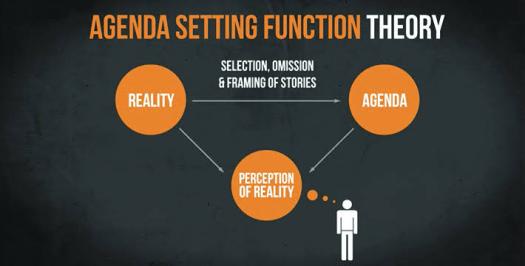
While in class this week, we discussed the Agenda Setting Theory. The Agenda Setting Theory focuses on the relationship between what we think and how mass media portrays information to us. Ultimately, the news will concentrate on certain issues which leads the public to think that these issues are more important than others. The press does not always reflect reality, and they also filter it to make us believe certain things. This theory is so important because, it shows that the publics thoughts can be altered to believe what the news wants it to believe.
The Agenda Setting Theory is not the only way that our thoughts can be altered by another person. Another example of how human behavior can be affected is its compliance to authority. There have been multiple experiments done to show that people comply to authority quite easily. Two that we learned about in class this week are the Milgrim shock experiment and the Stanford prison experiment. The Milgrim Shock Experiment was conducted by Yale University and psychologist Stanley Milgrim in 1961. The experiment would measure how people would obey to authority. Participants in the experiment were told that they were helping with an experiment, their job was to administer electric shocks to a “learner” in a different room. The participants were accompanied by the experimenter who acted as an authoritative figure. The electric shocks were fake, and the entire experiment was staged but the participants had no clue. Unbelievably, many of the participants obeyed the instructions and complied to authority. Many of these participants administered shocks that would have been fatal if the experiment they were helping with was real. 65 percent of the participants in the experiment administered the final shock, which was 450 volts, due to an authoritative figure telling them that they had to continue. Another experiment that would show how people obey authority was the Stanford Prison Experiment. This experiment was done in 1971 and conducted by a research group led by psychology professor, Philip Zimbardo. In the study volunteers were assigned to be guards or prisoners in a mock prison. The experiment was supposed to last two weeks but ended after 6 days due to the assigned guards acting in authoritative ways towards the prisoners. The study was done to investigate the effects of perceived power on an individual. Both experiments discussed in class showed the power of authority and how human beings comply to it.
 Mass Media & American Life - Fall 19