
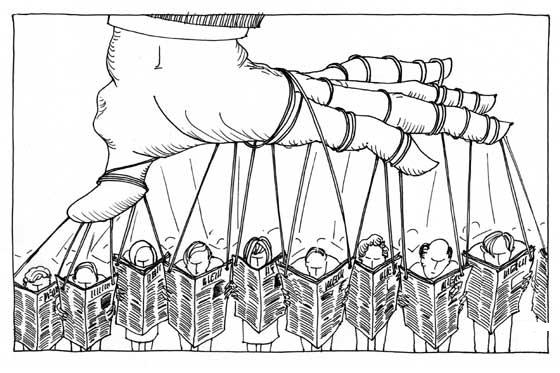
Over the past week in class we have gone in to pretty great depth of the connection between people and the media. Along with that, we focused on how the media has a way of choosing for the people how they should feel and what they should think. Sprinkled in with the effects of media were a couple examples of past experiments that truly changed the psychology world as well as the real world.
The theory used when talking about how the media tells people what to think is “Agenda Setting theory”. The definition of agenda setting is fairly straight forward; the media picks what they want the people to know and only show the one side that they agree with. In layman’s terms, the media outlets show certain things that they want the people to see while withholding other information that may be pertinent to the story. An example of this that was used in class was when MSNBC cut off a congresswoman speaking about important things going on in our country, to tell everyone watching that Justin Bieber had been arrested for street racing. In a case like that it is simple to see that MSNBC may not have agreed with what the congresswoman was speaking about so they just shut her down. We can see instances such as this all over but we must be aware that it is going on.
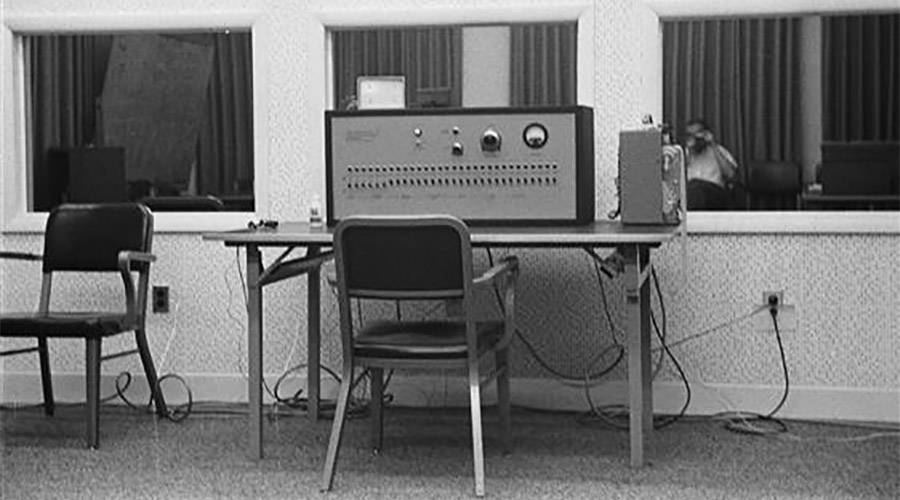
Moving into the social experiments, the first one we spoke about was the Milgram Shock Experiment. Stanley Milgram was a professor at Yale University when he conducted this experiment in 1961. The basis of his experiment was to find out how far people would go with something if they had someone of an authority position was telling them too. In Milgrams experiment he had random volunteers sit behind a device which they though was shocking someone in the next room (even though the person in the next room was part of the experiment and not getting shocked at all). they would then read questions and deliver a shock for wrong answers. Milgram was very surprised to see that many people went all the way up to fatal shock levels simply because he had a doctors coat on and was telling them too. This shows that people respond in a certain way to authority.
The second experiment was the Stanford Prison experiment put on by Philip Zimbardo while he was a professor at Stanford University in 1971. In this experiment Zimbardo split the volunteers into two groups (guards or prisoners). As the experiment progressed you could see how the guards started talking the role a little too serious and began to actually mentally mess up the prisoners. They were in a position of power and began to abuse it. This is connected to agenda setting because the media outlets abuse their power and just tell people what they think the people should know.
People should be aware of the agenda setting that is constantly going on and not let it decide their views. We should be gaining our information from multiple sources so we can choose our own outlook on anything.
-Shane Weber
 Mass Media & American Life - Fall 19